
The 4 Key Types of Pain

This article is used with permission from the new book, PAIN RELIEF in 4 Simple Steps by Jacob Teitelbaum, MD. If you’re interested in this topic and would like to see all the articles published so far, visit Healing from Chronic Pain, a Multipart Series.
Pain is a skyrocketing epidemic. About two-thirds of adults suffer with pain, with 1 in 4 having chronic pain that has lasted more than 3 months. About 7% of people have chronic pain that is so severe it interferes with their ability to function.
So, you are not alone.
When we are suffering from pain, much of the misery comes from not understanding it, and feeling like there’s nothing we can do about it.
But you can get pain-free. I will show you how.
Let’s start with understanding the pain.
Pain is not an outside invader attacking your body. It is not something you’re helpless to do anything about.
Rather, pain is simply part of your body’s monitoring systems telling you that something needs attention. It’s like if your hand is on a hot stove. The pain tells you to move your hand.
It’s one thing when the cause of the pain is obvious, like an injury. But our bodies have monitoring systems for other things as well, just like our car’s dashboard has many different lights.
Let’s start with a brief summary of what each kind of pain is telling you.
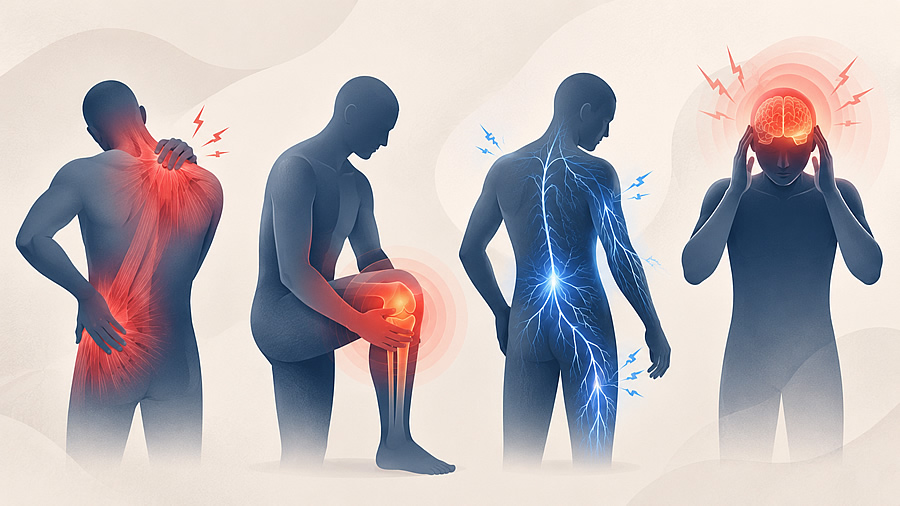
1. Muscle Pain
Muscle pain, which is the most common type of pain, mostly comes from shortening of muscles. When a muscle gets locked in the shortened position, it hurts. It will often feel like the pain is deep. Interestingly, both the pain and tenderness can be felt in areas that are inches to feet away from the chronically shortened muscle.
For example, the classic tension headache felt in the temples and across the forehead comes from tight muscles about three finger widths below the ear lobes (more on this later).
Muscles attach to bones using tendons. When the muscle is chronically shortened, it pulls on the tendon, inflaming the tendon and causing tendinitis.
Muscle shortening is usually caused by inadequate energy in the muscles.
Low Cellular Energy Causes Muscle Pain
It takes more energy for muscles to relax than to shorten. Muscle shortening, which is a key cause of muscle pain, is usually caused by inadequate energy in the muscles.
Increasing energy in the muscles helps them to relax, so the pain can go away.
2, Inflammation Pain
This can come from injury or infection. But given the modern “high-inflammation diet,” the problem is often simply that our inflammation and immune systems are set on overdrive.
3. Nerve Pain
Neuropathy is also associated with inadequate energy in the nerve. This causes the “pacemakers” in the nerve to keep firing, exhausting the nerve and triggering pain.
4. Brain Pain (Central Sensitization)
Virtually all chronic pain and many other severe stresses to the brain trigger a form of brain cell inflammation called microglial activation. It has many components and many other names, but what is important to know is that the brain pain then markedly amplifies the pain. It can even cause pain to persist once the original problem is eliminated.
The good news? Several safe, effective, low-cost and readily available treatments do a good job of turning off the brain pain. It’s kind of like rebooting your computer when it goes on the fritz.
Although there are other pain triggers (for example injury and tissue compression), these four are the main ones involved in most chronic pain.
Treat the Whole Process
Once any type of these pains becomes chronic, it can trigger the other three.
So, in chronic pain, it is best to treat all four of these at once.
Which is easy to do.
You’re Invited! Dr. Teitelbaum is now personally answering questions in his new Facebook support group: Recovering from Fibromyalgia, CFS, and Long COVID. The group is also open to anyone dealing with chronic pain or related health challenges. Join the community, ask your questions, and connect with others!